Introducing Universal Framework Support
Agents that autonomously model your security portfolio to any framework, consistently and at scale.

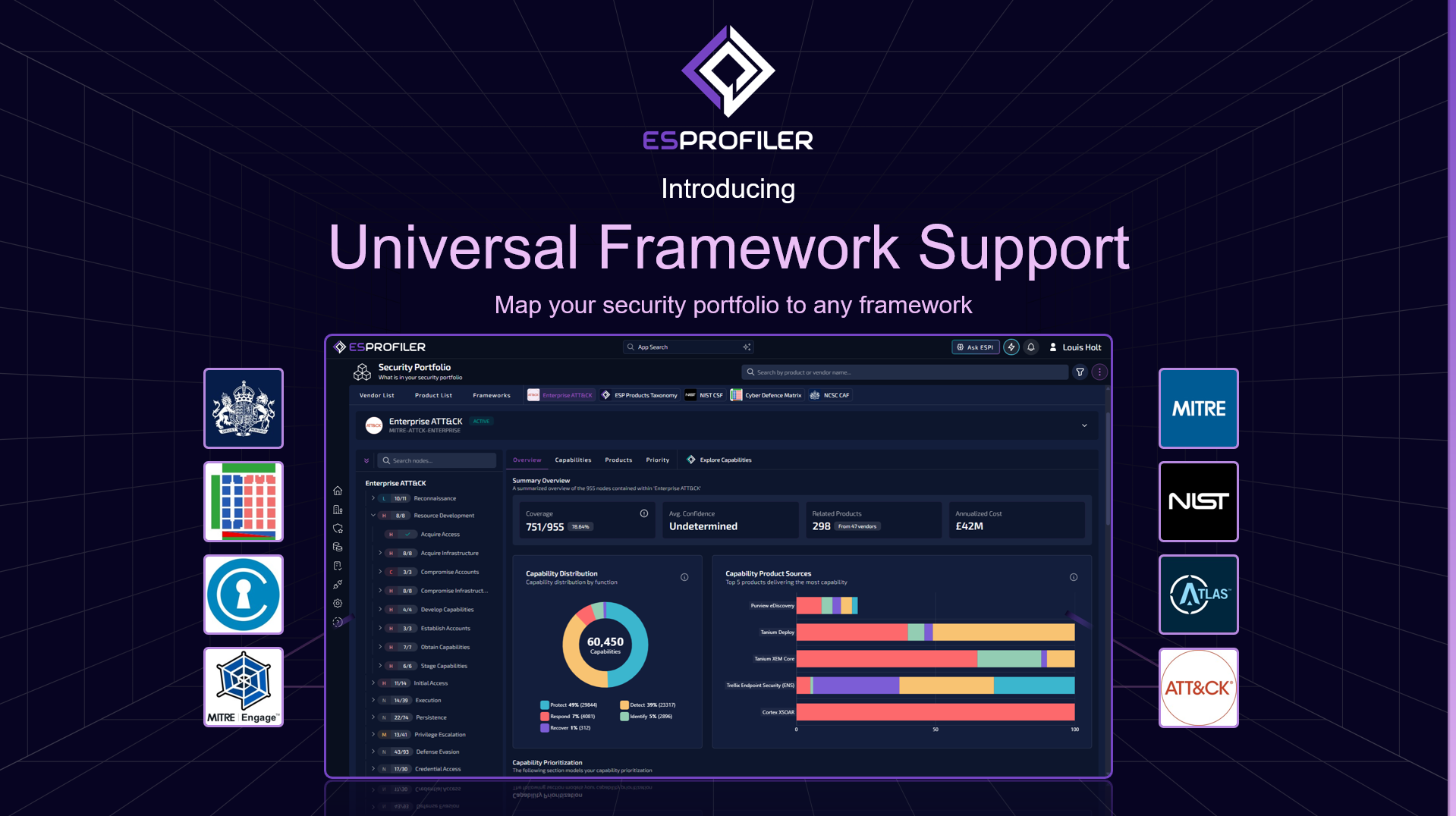
Today, we are extremely excited to announce a major uplift in ESPROFILER’s capabilities.
We are introducing Universal Framework Support, a foundational update that changes how ESPROFILER's Capability Agents model, understand, and work with security frameworks of all kinds.
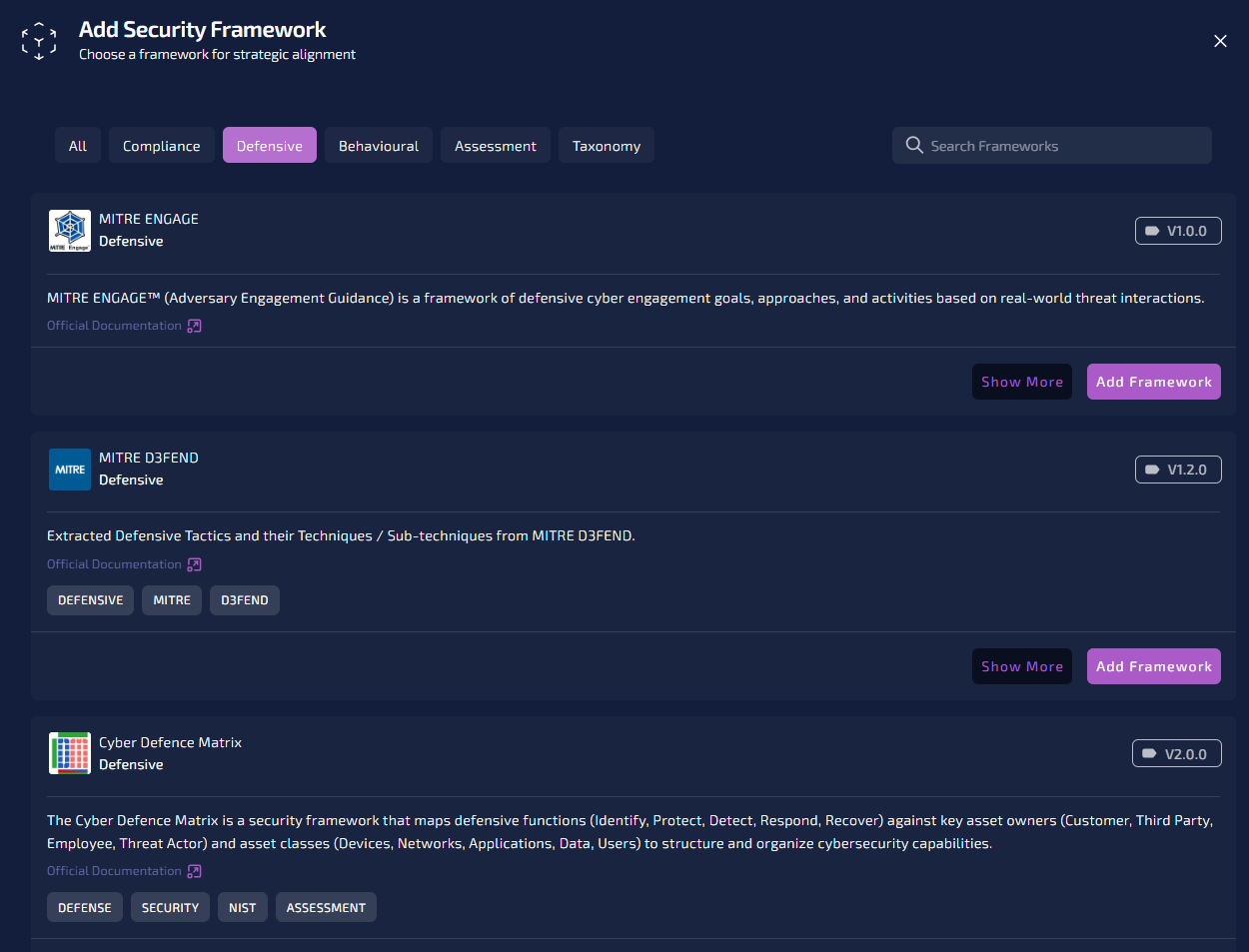
This is not about adding support for one more framework. It is about supporting any framework, consistently, accurately, and at scale... NIST, MITRE, CIS, ISO, PBOM, Cyber Defense Matrix, Insider Threat and even your own internal frameworks!
Why We Built Universal Framework Support
Much of the industry assumes MITREATT&CK as a baseline, yet many organizations are not operating with MITRE at all. Others need to reason simultaneously across defensive frameworks, compliance standards, assessment models, and their own internal taxonomies.
Internally, this complexity was reflected in the platform. Different frameworks were modeled in different ways. Visualizations, summaries, and cost analysis varied by framework type. Adding or extending a framework often required bespoke backend logic and custom frontend components.
The result was inconsistency, duplicated effort, and limited extensibility.
Universal Framework Support is how we address that.
A Simple Realization With Big Consequences
At the heart of this work was a simple realization.
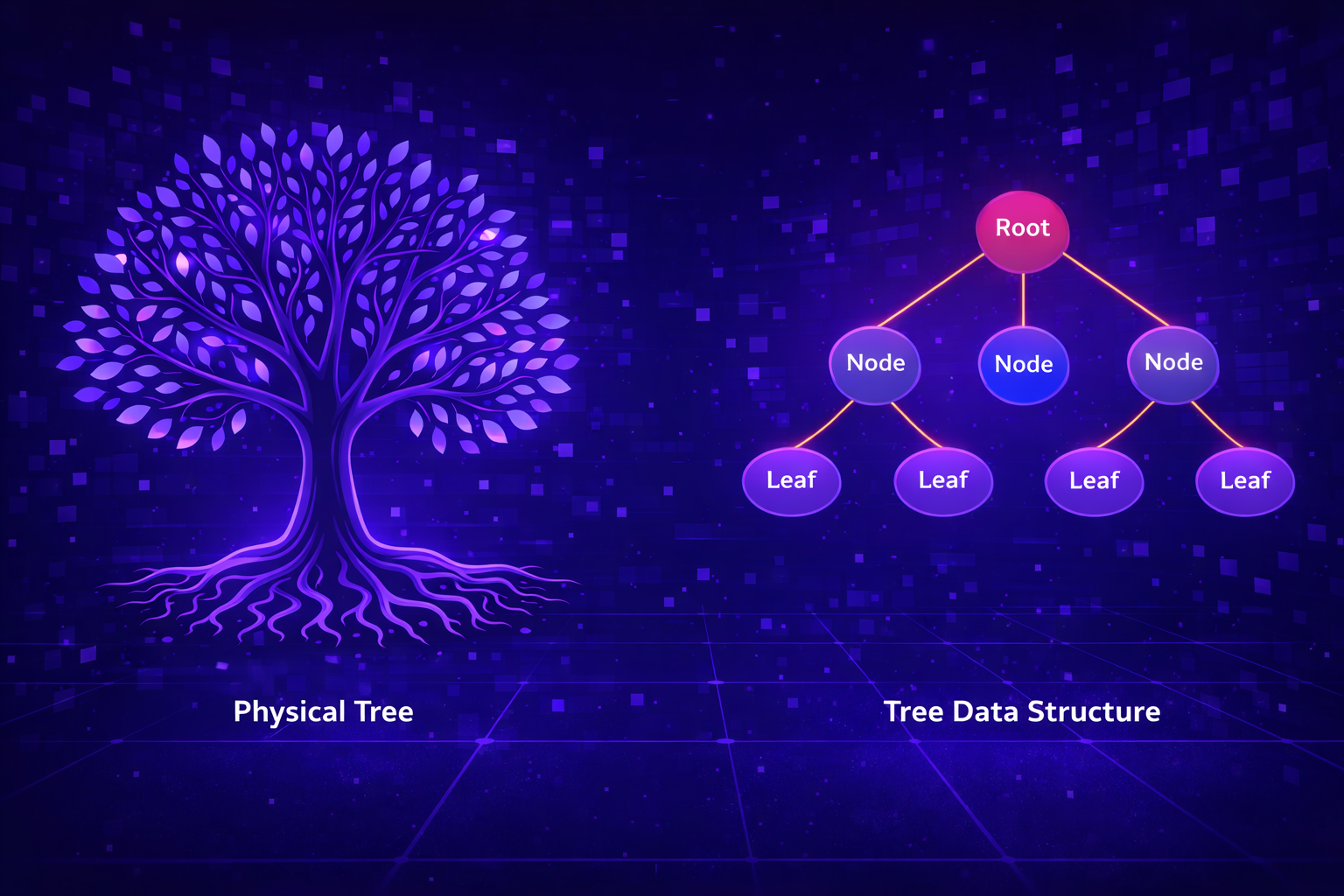
Every framework, whether it describes adversary behavior, defensive controls, compliance obligations, or abstract categories, can be represented as a tree.
There is a root that defines the framework. There are then hierarchical nodes that add structure. Finally, there are leaf nodes that represent the most granular capabilities, controls, or behaviors.
At any point in that tree, users want to answer the same questions.
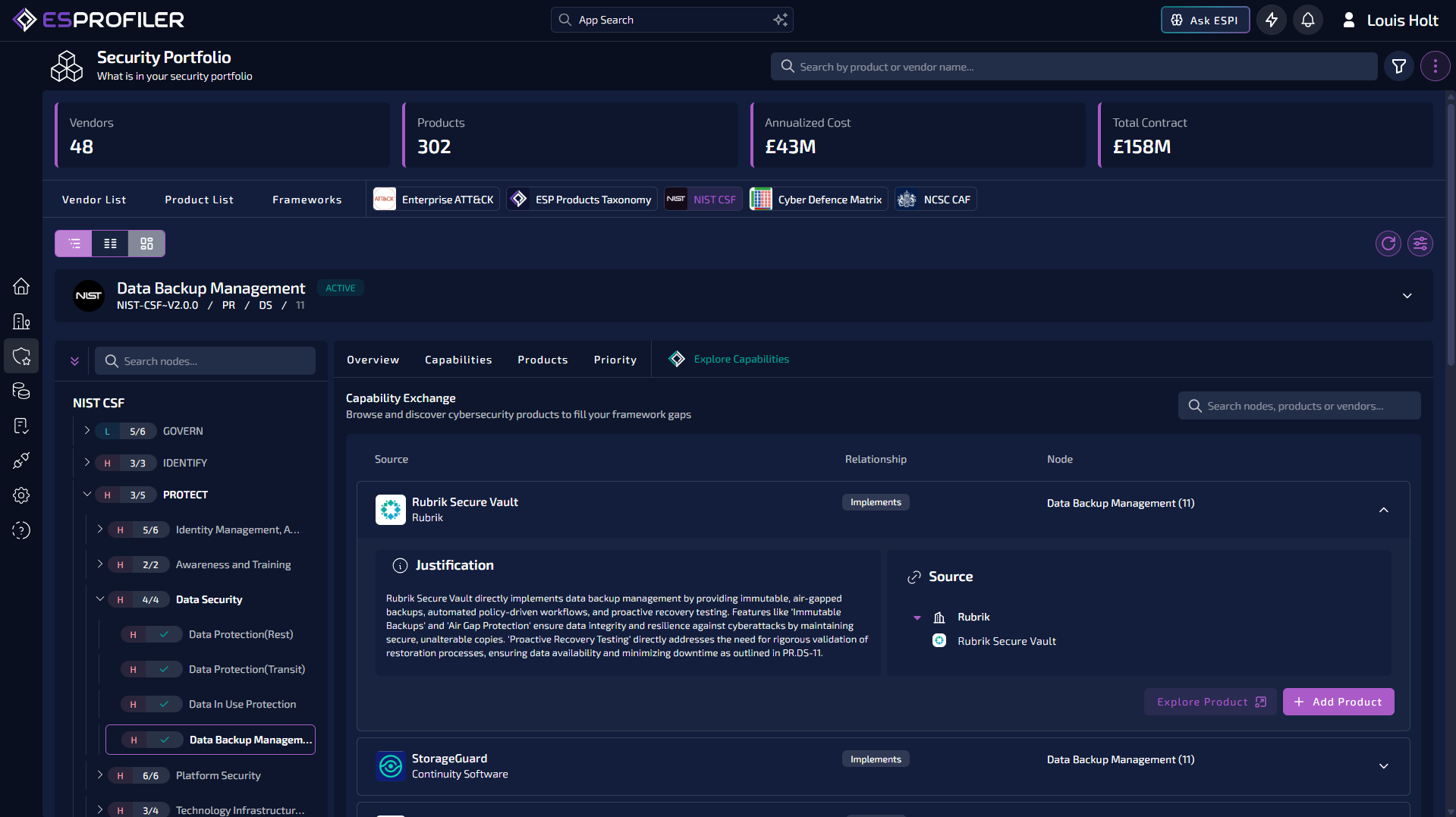
- What is covered, where are our gaps and what would fill those gaps
- What does our current coverage cost
- What is the priority and what is our confidence
- What exists in the market to address this
Once frameworks are treated this way, they stop being special cases and start being data that can be reasoned about consistently.
The Framework Description Model
Universal Framework Support is built on a new schema that we designed and built from the ground up, called the Framework Description Model (FDM).
FDM is a universal JSON and YAML schema for describing frameworks as strict, validated trees. It defines consistent rules for hierarchy, naming, paths, metadata, and versioning, allowing frameworks to be machine-readable, query-efficient, and comparable over time.
A core design requirement of FDM is the ability to uniquely reference and relate any item within a framework, even across version changes. This capability does not meaningfully exist across frameworks today and is essential for long-term analysis, comparison, and evolution.
Rather than embedding framework-specific logic into ESPROFILER, we describe the framework itself. ESPROFILER then operates on that description.
This approach decouples the platform from individual frameworks while preserving deep structural understanding. Supporting a new framework becomes a matter of authoring a description rather than writing custom code, which dramatically reduces maintenance overhead and manual effort.
Our long-term goal is to open source FDM and return it to the broader community.
Prioritization as a First-Class Capability
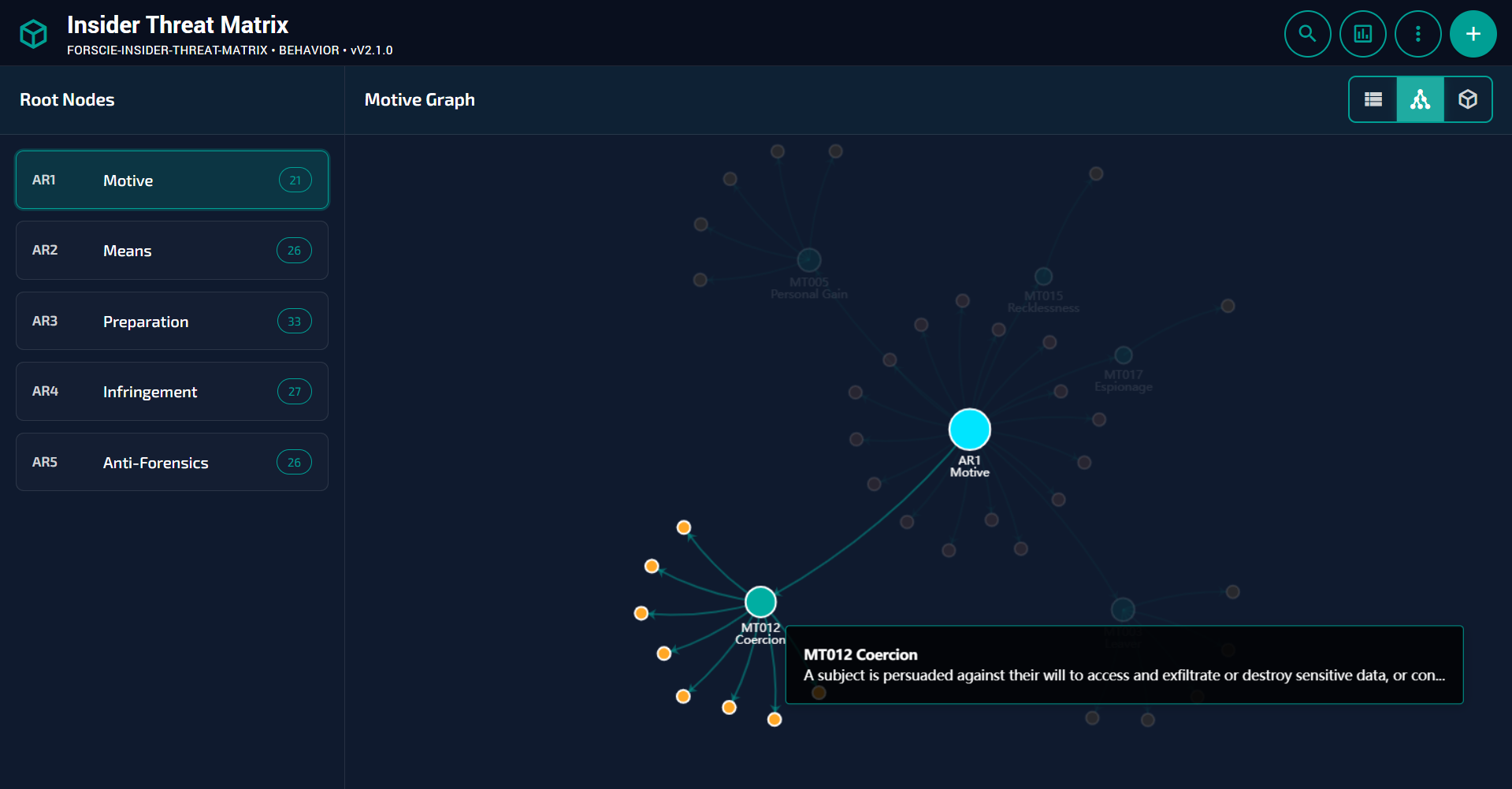
A critical part of Universal Framework Support is the ability to apply prioritization layers directly to frameworks. This allows customers to analyze how well security capability and current spend is aligned to what matters most.
Traditional frameworks implicitly represent every node as equally important. In practice, they never are. Some adversary techniques are actively exploited. Some controls are critical to specific business environments. Some gaps demand immediate investment, while others can be deferred.
Universal Framework Support allows customers to apply dynamic prioritization to any framework, turning it from astatic structure into an intelligence-driven decision lens.
Prioritization can be driven by multiple inputs, including threat intelligence, business context, regulatory focus, or customer-defined strategy. For example, customers can overlay current threat intelligence onto MITRE ATT&CK to focus investment on techniques that are most relevant today i.e. threat informed approach, rather than distributing effort evenly across the framework.
Equally, organizations can prioritize frameworks based on business needs, highlighting which capabilities, products, or features are essential for a particular environment, zone, or use case. As always in ESPROFILER this prioritization capability is exposed via UI and our open API, allowing customers to integrate their own data sources and continuously adapt priorities as conditions change.
Handling Versioning and Change as First-Class Concepts
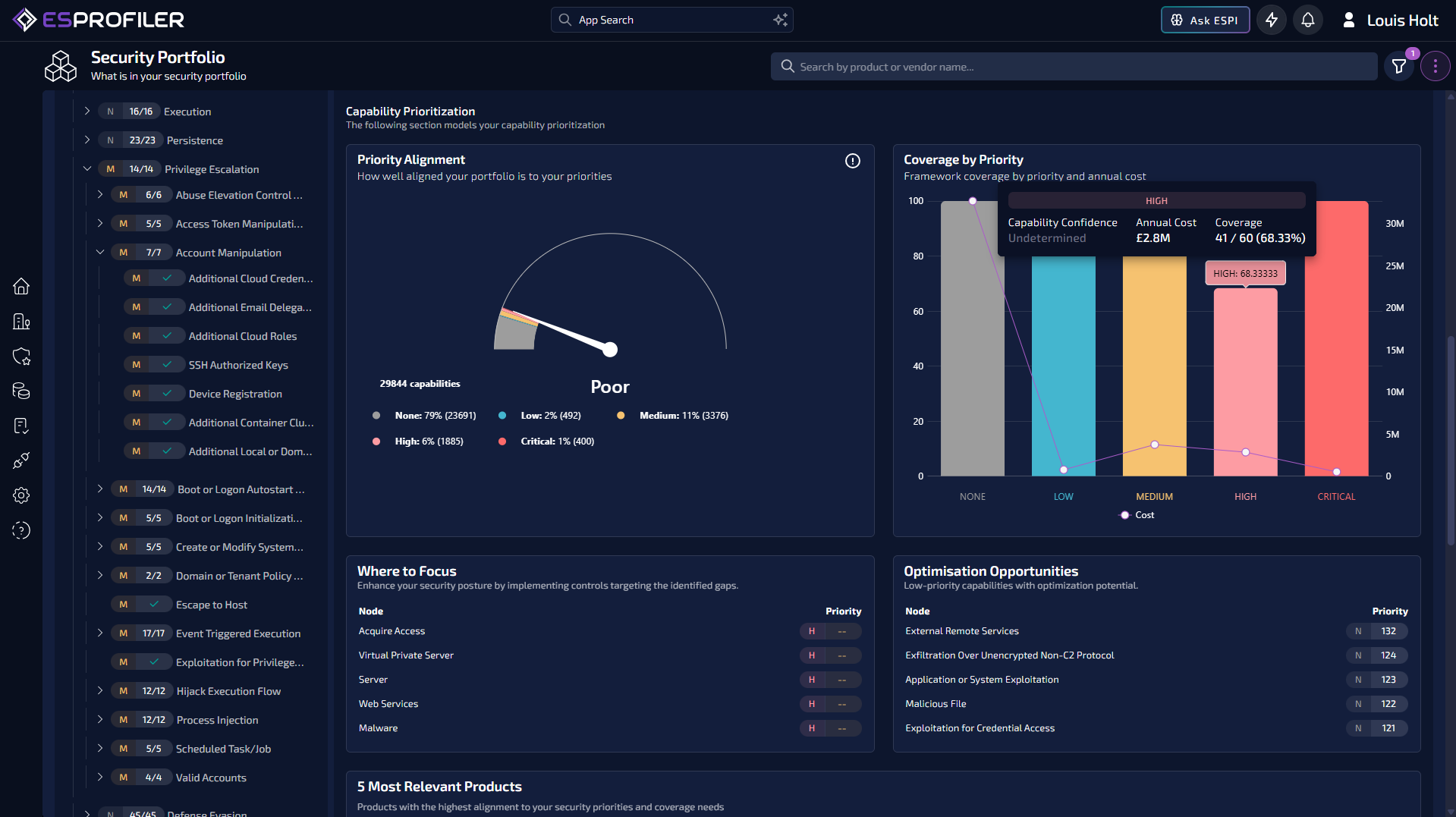
Frameworks change. Nodes are added, deprecated, split, or replaced. Products evolve, capabilities shift, and mappings that were correct yesterday may not be correct tomorrow.
Universal Framework Support is designed to handle this complexity natively.
Framework versions are explicit and traceable. Nodes can be marked as active, deprecated, or replaced, allowing ESPROFILER to model changeover time rather than hiding it. Relationships inherit and summarized correctly across hierarchy, ensuring that coverage, cost, and priority remain meaningful even as structures evolve.
This allows customers to work with the latest versions of frameworks while still understanding how changes impact historical analysis, reporting, and decision-making.
One Engine, Many Frameworks
With Universal Framework Support, ESPROFILER can model and analyze fundamentally different types of frameworks inexactly the same way.
- Adversary behavior frameworks
- Defensive and hardening frameworks
- Compliance and regulatory standards
- Assessment and threat modeling frameworks
- Internal taxonomies and category models
All are treated as first-class citizens. All share the same underlying engine. All benefit from the same coverage, cost, priority, and change analysis.
A single product or capability can map to multiple frameworks and multiple nodes without duplication or artificial constraints.
What This Unlocks
Universal Framework Support dramatically reduces the manual effort required to map security tooling and controls to frameworks. Instead of maintaining fragmented, one-off mappings, customers gain a unified intelligence layer that understands how capabilities align across multiple frameworks at once.
This allows teams to move beyond static mappings and spreadsheets, and instead reason dynamically about their security posture. Customers can quickly identify coverage gaps, areas of overlapping investment, and opportunities for consolidation or divestment, all through a consistent framework lens.
Because capabilities are modeled once and applied across frameworks, customers can compare products more objectively, understand true capability overlap, and make clearer investment decisions. As frameworks and products evolve, insights remain current without repeated manual rework.
The result is faster analysis, more confident decisions, and a continuously up-to-date view of security capability across the entire portfolio.
Discovering Solutions Through Frameworks
Universal Framework Support is not just about analysis. It also changes how customers discover and evaluate solutions.
Customers will be able to search for vendors, products, and capabilities that align with the frameworks they care about. Whether the goal is improving coverage against a specific adversary technique, strengthening a defensive control area, or addressing a compliance requirement, frameworks become a practical discovery and decision-making tool.
Because mappings are consistent and version-aware, customers can trust that what they see reflects both the current state of the framework and the current capabilities of the products being evaluated.
What’s Next
This announcement marks the beginning of a broader shift in how ESPROFILER approaches capability mapping and analysis.
In the coming blogs, we will share deeper technical detail, practical examples of framework descriptions, and guidance on building and sharing custom frameworks. We will also explore how Universal Framework Support enables more powerful portfolio modeling and what-if analysis across organization and zones.
For now, we are proud to introduce Universal Framework Support and to take a meaningful step toward a more flexible, extensible, and future-ready ESPROFILER.




.png)


